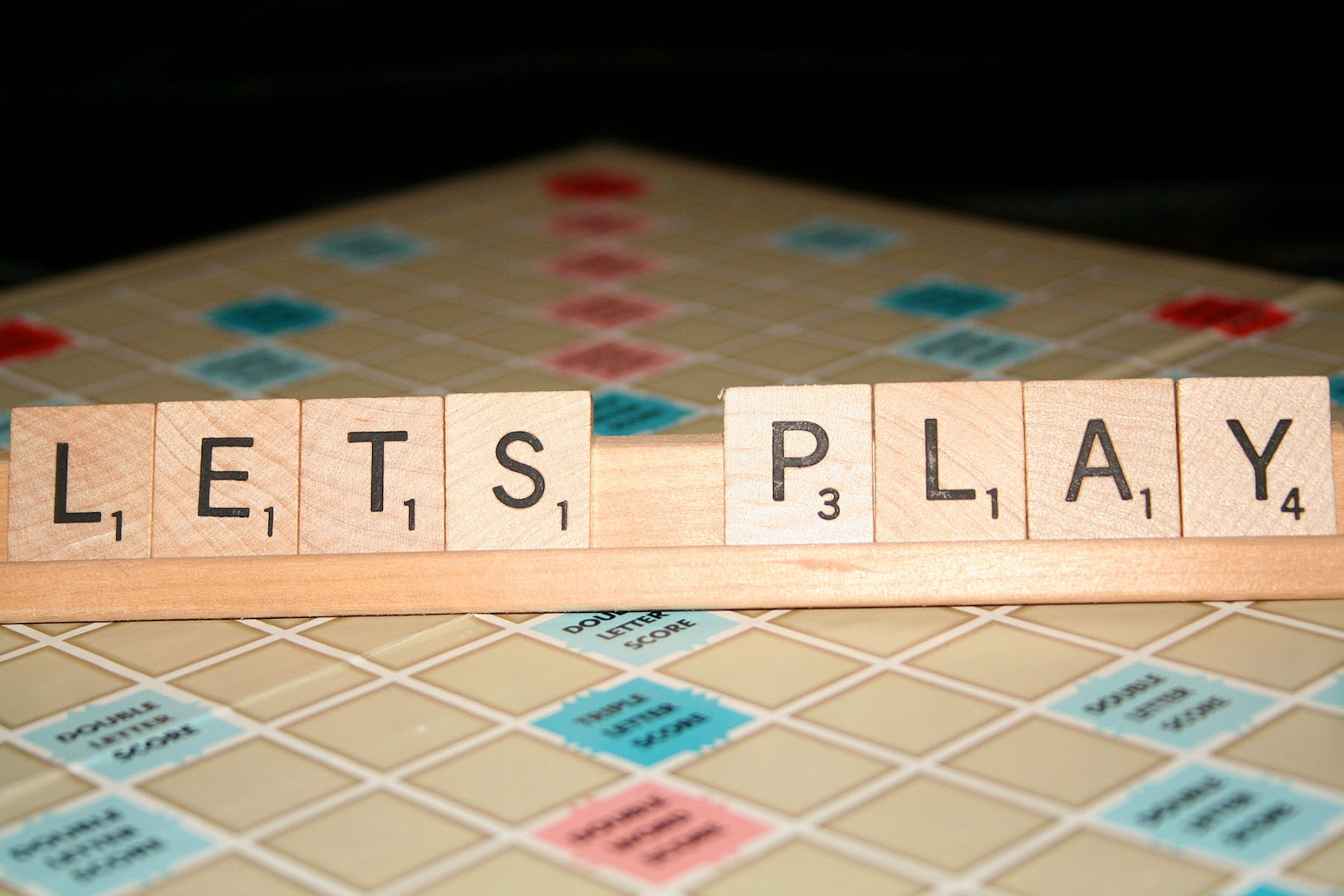
Scrabble™ is a word game that Offred and the Commander regularly play during Offred’s private visits to his office. In my scene, this game is being played when Offred begins to flirt with the Commander, hence the mildly-suggestive “LETS PLAY” spelled out in the photo above.
Image Courtesy of Hasbro Inc.
I think I’ve fallen in love with Margaret Atwood’s The Handmaid’s Tale. In her novel, she skillfully applies a unique writing style to bring a complex and relatable protagonist to life. She has inspired me to write my own scene that stays true to the style and plot of the original novel while portraying the depth of Offred’s character. Below, I’ve included my new scene and a description of how I modelled my piece to match Atwood’s expert manipulation of stylistic devices, representation of Offred’s insight and character duality, and vivid realization of a sex-deprived totalitarian society.
New Scene:
Love? He laughed as I drew more tiles from the bag. He watches me with an expression of amusement, as if I were a small child that he had caught lying.
I shook my head. What word had he expected me to put? Almost all the good spaces on the board had already been filled.
Another loss, I shrugged. I should give you a prize for winning.
And what would that be? He laughed, eyes glittering with interest.
I slowly swept the tiles off the board. I diverted my attention to my fingertips, bare, which traced the top of the board gently. He leaned forward and set his elbows on top of his knees.
I have a few things in mind, I whisper to the board. I realize that I have his full attention.
Is that so? He smirked, raising an eyebrow. I circle and stand behind his chair, placing my hands gently on his shoulders. He flinches at my touch. I was toying with him, I knew it, but I had just flipped a switch and wouldn't stop now. I knew the Commander longed for love. His lingering desires, extinguished long ago by his wife, were now flaming with a need for passion. I wanted to simultaneously wrap my hands around his throat and strangle him, and massage his shoulders at the same time. I went with the latter.
His shoulders loosened under my tender touch. I wanted to do more. I wanted to make him feel like he had made me feel. Vulnerable, powerless, and under someone else’s control. I leaned my head down towards his, and his lips parted in anticipation. My fingers froze.
I stepped back. He dropped his head. I sensed that he was disappointed. I returned to the table and finished packing away the game, avoiding his gaze.
He leaned back into his chair.

The Handmaid’s line up in their distinctive red robes and white hoods, preparing for a government-ordered event. Note how they are present in body, but their physical position indicates an absence of awareness of their surroundings. This psychological isolation is similar to what Offred demonstrates in response to her harsh reality.
Image Courtesy of Hulu.
Style - Syntax and Punctuation
Atwood’s choice of literary style has a distinct impact on the effect The Handmaid’s Tale has on its readers. More specifically, the examination of the novel’s syntax and punctuation reveals the sensitive nature of Offred’s character and furthers the story’s development as a retold account of Offred’s life. Throughout the novel, Offred’s narrative fluctuates significantly in sentence and paragraph length. She retells pre-Gilead memories using complex sentences and long paragraphs, but only uses short, succinct paragraphs when describing the present. This variance in syntax demonstrates how Offred used to capture events in her life vividly, not wanting to forget any details, but she now limits herself to simple observations, avoiding complex thought as a means of protecting herself from her harsh reality. In addition to the novel’s unique syntax, The Handmaid’s Tale shows an interesting choice of punctuation through the lack of quotation marks for dialogue. According to this student in New Brunswick*, the lack of quotation marks is meant to reinforce how Offred is only able to paraphrase her conversations from the past. As a result, Offred’s story is reconstructed from her memory and the dialogue is permanently tinted by her perspective. The syntax and punctuation use in The Handmaid’s Tale is an important component of the novel because it demonstrates Offred’s sensitivity to her harsh living conditions through her selective memory and supplements the framed style of narrative of the book as a whole. Therefore, when writing my new scene, I made sure to apply a similar writing style using short paragraphs and no quotation marks so that the stylistic devices in my scene reinforce the meaning communicated in Atwood’s novel.
* If the link doesn't work in this blog format, here it is: http://wh.rutgers.edu/creativecwriting/student-writing/353-jacqueline-pelliccio-language-of-oppression-in-the-handmaid-s-tale

Offred meets her walking partner for her daily outing. Despite their similarity in circumstance, the Handmaids have different thoughts and values, just like how Offred’s character presents two distinct internal desires.
Image Courtesy of Hulu.
Character - Offred’s Duality and Insight
In my scene, my focus was the enhance the duality demonstrated by Offred’s character in the book. Offred constantly battles between her desire to take risks and gain power and her apprehension of consequence. She nearly attempts to steal a withering flower from the wife's bouquet just to feel in control of something, and she daydreams about using her only match to "burn the [Commander’s] house down" (209). However, she always fails to act on these desires out of fear of punishment This internal conflict between two opposing forces is similar to how the protagonist of E. L. James’s Fifty Shades of Grey struggles between her desire to seek immediate sexual gratification and her understanding that her current relationship is unhealthy and unsustainable. My scene reflects this major aspect of Offred’s character by revealing how she considers teasing the Commander sexually and later strangling him to death but instead retreats into herself as opposed to taking action.
Also, in order to make Offred’s personality consistent with the rest of the novel, I reviewed her thought process during several other situations she encounters during the book. Firstly, the comment I included about the Commander’s desires being extinguished by his wife is factually true. In the novel, Offred comprehends that the Commander and his wife fail to connect anymore. Secondly, the familiar manner that Offred and the Commander converse is another aspect of my scene that is faithful to the text. They do in fact speak to each other casually during their later encounters. Lastly, Offred understands that “[i]t isn’t a lack of sex we die from, it’s the lack of love” (104). In my scene, she successfully evaluates the Commander’s desperate need for affection and uses that to manipulate him to her advantage.

Offred lies on her back once a month for the Ceremony, hoping to become pregnant. However, the Ceremony itself is notably less sexual than the other examples of tension between Offred and the Commander in the novel.
Image Courtesy of Hulu.
Plot Events - Setting Selection and Sexual Tension
My creative response fits the novel’s plot in context and in content. In my scene, Offred makes her routine visit to the Commander’s private office where they play Scrabble and there is an abundance of non-sexual sexual tension. Both of these aspects are prominent in The Handmaid’s Tale. In the novel, Offred regularly visits the Commander’s office where they play Scrabble. In addition, Atwood always italicizes the words that the characters place on the board and those words often allude to the motifs of the play. Therefore, the context of my scene and my selection of the word “love” are both completely appropriate for the novel. The non-sexual sexual tension between Offred and the Commander in my scene is also a skillful inclusion of plot aspects from the book. The society of Gilead has been deprived of expressions of sexuality for years. Lingerie stores have long been shut down, porn magazines have all been burned, and women now dress to hide their skin. As a result, the world that Offred lives in is highly sensitive to anything remotely sexual. Often, Offred uses this sensitivity to her advantage. For example, she decides to move her hips a little while walking past some young Guardians, hoping “they get hard at the sight of us and have to rub themselves against painted barriers, surreptitiously” (22). My emphasis on the movement of Offred’s bare fingertips against the Scrabble board aligns itself with the same style of barely-sexual sexual tension included in the book. Furthermore, the tension between Offred and the Commander is also appropriate because in chapter 25, the Commander teases and lures Offred using a Vogue magazine. This example shows that this form of sexual tension is not only present in the streets of Gilead, but also in the context of my selected scene.
Work Cited
Atwood, Margaret. The Handmaid’s Tale. New York, USA: Anchor Books, 1998 ed. Print.

Hello Miasya,
ReplyDeleteWonderful post analyzing the sexual tension between Offred and the Commander. The Handmaid's Tale is one of my favorite novels. It's themes of owning a women's body, the power of words, and the causes and detriments of complacency are incredibly deep. It is a great novel that I think all women should read to be informed about the workings of the patriarchy and how to resist against the white menace.
Another novel, which is one of my favorites, that goes into sexual tension and intimate partner violence, is "If You Give A Mouse A Cookie" by Laura Numeroff. To start this analysis, you must consider what the young boy and the mouse symbolize. The boy, who is innocent and enjoying life on his lawn, represents pure women before they have been corrupted by men. The mouse, which is the size of most men's plonkers, obviously represents men.
The boy and the mouse first meet outside of the boy's house. One gaze into each other's eyes is all it takes for the boy to be captivated by his false charm and hairy chest and for the mouse to realize he has found the next person he can abuse and cheat.
The man quickly hits it off with the girl. First, he acts for a date, which escalates to them moving in with each other. Instead of contributing at all the household, the guy keeps making more and more demands of his girlfriend. She continues because, like a lot of girls, she is a slave to society's gender roles and has been demeaned enough to demand acceptance.
Their relationship quickly escalates. When the mouse lays down in the make-shift bed, there is a red blush on its face. This red blush is to signify that the mouse is intoxicated. All men are slaves to alcohol, and because of this the relationship worsens.
When the mouse jumps out of the bed, a red bandanna is seen coming out the bed. The mouse is not actually jumping out of the bed to make a picture, he is actually leaving the house in a drunken tirade to join the Bloods because all guys think guns and violence are cool, especially when they are drunk.
The dangers of being in a gang and fighting the Crips puts even more stress on the couple, however, despite the girl being forced to take on most of the work in the relationship, they still manage. In the end though they are left in shambles, their house a mess, as the Crips have found their location. Right before they're shot, the story of how they met flashes before their eyes.
What most people don't know is that the story continues. Only the man died, which is okay because all men are sinners, and the girl lived. However, the girl, since she had fallen pray to the allure of men and was deprived of any economic sources, became a prostitute and eventually died of a drug overdose. This shown by how sleepy and dead the boy looks on the final page
In conclusion, don't date guys, especially white ones, because they'll just treat you like crap, die, and then leave you.